How to convert an MP3 to text
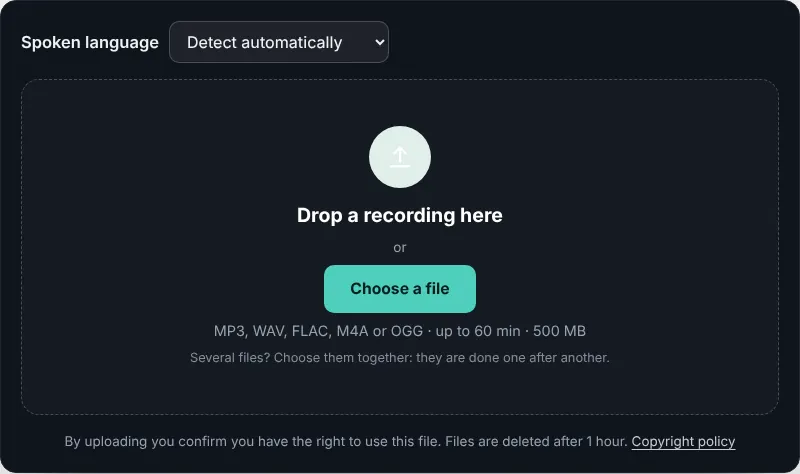
- Choose the MP3 file (or WAV, FLAC, M4A, AAC, OGG or OPUS), up to 60 minutes and 500 MB.
- Leave the language on "Detect automatically" or pick it, then wait while the AI transcribes it on our servers.
- Read the transcript, correct any word, and download it as a TXT or Word file, or as SRT and VTT subtitles.
Does the MP3 quality matter?
Less than you might think. Speech recognition only needs the frequencies of the human voice, so a 64 or 128 kbps MP3 of a clear voice transcribes as well as the original WAV. What matters much more is how the voice was recorded: distance to the microphone, echo in the room and noise around the speaker. A phone held close to the mouth beats an expensive microphone on the other side of a meeting room.
If the file is a long podcast or an audiobook chapter, cut it into parts of up to 60 minutes and choose them together: they are transcribed one after another, each with its own download.
Other audio formats
The same tool handles WAV recordings from a recorder or a DAW, M4A files from iPhone Voice Memos, OPUS and OGG voice messages from WhatsApp and Telegram, and FLAC. There is no need to convert to MP3 first. If you have a video instead, use video to text, or extract the sound with MP4 to MP3 right in your browser.
Check and correct the transcript in the page
Your transcript opens as a list of short lines, each with its time. Play your file in the page and the line being spoken lights up. Click a time to jump to that moment, and click any line to fix a word, a name or a spelling. Every download is made from the text as it is after your corrections, so you never have to fix the same mistake twice in two different files.
- TXT for notes, articles, emails and AI summaries.
- Word (DOCX) for documents you will edit further or share.
- SRT and VTT subtitle files for YouTube, Vimeo, Premiere Pro, DaVinci Resolve, CapCut, VLC and most other players and editors.
- Copy all to paste the whole text anywhere.
Turn on "Timestamps in text" to add a [minutes:seconds] mark at the start of every paragraph, which makes it easy to find a quote again in the recording.
How the AI speech to text works
The transcript is made by Whisper, an open speech recognition model released by OpenAI under the MIT licence, running on our own servers. Whisper was trained on hundreds of thousands of hours of speech in many languages, so it copes with accents, background noise and fast speakers far better than the speech recognition built into phones and office software a few years ago. It also adds punctuation and capital letters, so the text reads like writing rather than a stream of words.
Before the model listens, a voice detector skips long silences and music-only parts, which keeps the timing accurate and stops the AI from inventing words where nobody speaks. The model also records the time of every word, and we use those times to cut the text into lines that are short enough for subtitles: at most two lines of 42 characters and about seven seconds on screen.
Frequently asked questions
Can I convert several MP3 files at once?
Yes. Choose them together and they are transcribed one after another, up to 10 files a day. Each file gets its own downloads.
Which languages does it understand?
About 100, including English, Spanish, Portuguese, German, French, Italian, Greek, Arabic, Hindi, Chinese, Japanese, Russian and Turkish. Accuracy is highest for widely spoken languages and lower for languages with little training data. Leave "Detect automatically" on, or pick the language yourself.
Is the text exactly what was said?
Close to it, with punctuation added. Filler sounds such as "um" and false starts are usually left out, which makes the text easier to read. If you need a strict word-for-word record, check the transcript against the recording in the editor.
Is it really free?
Yes. There is no account, no watermark and no paid tier. The site is paid for by the adverts you see on the page. To keep it fair for everyone there is a daily limit of 10 files per visitor.
What happens to my recording?
It is transcribed on our own servers and deleted automatically, together with the transcript files, 1 hour after you upload it. Nobody listens to it, we do not share it, and we never use it to train AI models. Playback in the editor uses the copy on your own device.
Can I transcribe other people?
Only upload recordings you are allowed to use, for example your own meetings, interviews where the other person agreed to be recorded, or lectures you may record. The rules on recording conversations differ between countries.